
Yoshikazu Yasuhiko Talks Gundam, Hand-Drawn Animation And The Future Of Anime
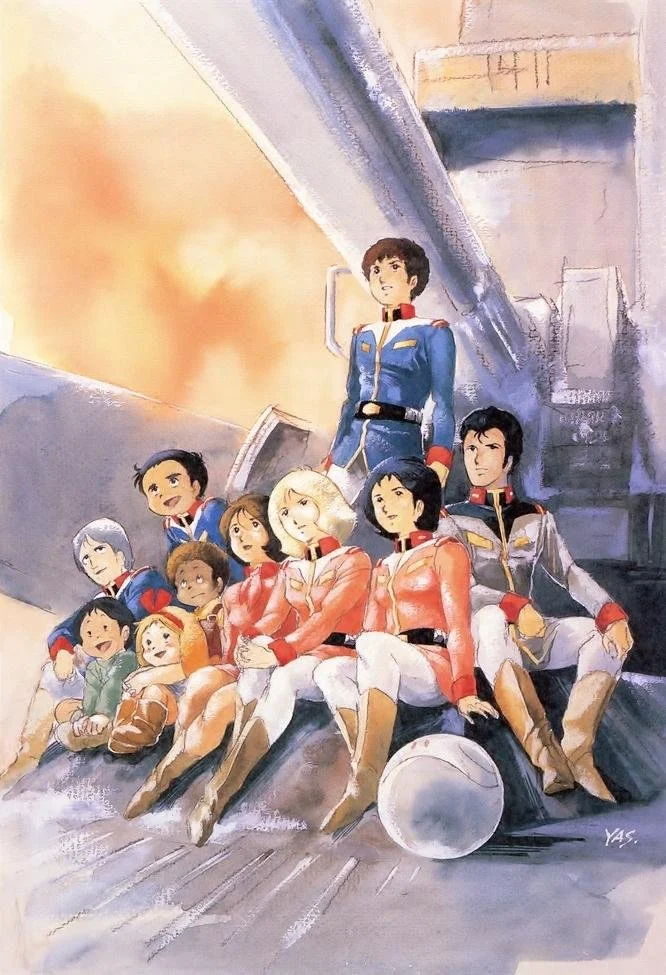
Illustrated by Yoshikazu Yasuhiko
Mobile Suit Gundam THE ORIGIN (White Base Crew)
Yoshikazu Yasuhiko, the legendary artist and director behind Mobile Suit Gundam THE ORIGIN, sat down with Look Back director Kiyotaka Oshiyama for a fascinating conversation about animation, drawing, artistic individuality, and the future of hand-drawn animation.
The special dialogue, titled “Why Do We Continue to Draw? ‘Mobile Suit Gundam THE ORIGIN’ and ‘Look Back,’” was held on July 20 at the Tendo City Museum of Art in Yamagata as part of the ongoing “Yasuhiki Yoshikazu: Divine Animator and Draftsman” exhibition.
Yasuhiko Couldn’t Stop Watching Look Back
The conversation was arranged at Yasuhiko’s request after he was deeply impressed by Look Back. Oshiyama readily agreed, joking that he might never get another chance to meet Yasuhiko.
Yasuhiko had already watched Look Back four times. He normally does not watch the same work repeatedly, but the film continued to reveal new details.
One scene that particularly caught his attention was Fujino running through the rain.
The scene appears as a single double-page spread in Tatsuki Fujimoto’s manga, but Oshiyama expanded it into a much longer animated sequence, including an 18-second cut designed to emphasize the movement and energy of animation.
Oshiyama revealed that one of his inspirations was the classic musical film Singin' in the Rain. He also drew from his childhood memories of running along paths surrounded by rice paddies.
Yasuhiko praised both approaches, admiring Fujimoto for expressing the scene through a single double-page spread while also praising the animators for transforming that still image into movement.
Why Look Back Used A Small Animation Team
The conversation then moved into one of the most interesting aspects of Look Back: its approach to drawing.
Yasuhiko noticed that the characters were not drawn with perfectly clean lines. Hair was messy and twisted, while certain shapes were intentionally distorted.
Oshiyama explained that this was deliberate.
Rather than relying on a large team working toward a uniform result, Look Back was produced with a small group of animators who were given room to draw individually. Oshiyama wanted to avoid a formulaic approach to character design and movement.
He even instructed the staff that the drawings did not have to be perfectly neat.
Yasuhiko immediately recognized how difficult that kind of direction can be.
“It’s easy to say ‘make it neat.’ It’s very difficult to say ‘don’t make it neat.’”
The discussion also led Yasuhiko to recall his work on Crusher Joe in 1983. He revealed that he handled all of the first key animation for roughly 1,800 cuts across the more-than-two-hour film, with only around ten other staff members, including newcomers.
That experience also connected Yasuhiko to veteran animator Toshiyuki Inoue, who later worked as a main animator on Look Back. Yasuhiko was delighted to discover Inoue’s involvement and praised him for continuing to produce great work.
Oshiyama went further, saying that without Inoue, Look Back would not have reached its level of quality.
Yasuhiko Looks Back At Gundam
One of the most interesting parts of the discussion came when the pair talked about the use of shadows.
Oshiyama explained that he wanted Look Back to have a clean visual style inspired by animation from the 1980s. He believed this approach allowed him to get closer to the essence of animation as an expressive medium.
That gave Yasuhiko an opportunity to look back at Mobile Suit Gundam.
Yasuhiko recalled that during production of the original 1979 TV series, scheduling and production limitations made adding shadows difficult. As a result, shadowless animation became common.
When the theatrical Mobile Suit Gundam trilogy was produced in 1981 and 1982, Yasuhiko finally had the opportunity to add shadows to newly animated scenes.
He remembered being so moved by seeing the results at the preview screening that he almost cried.
For Gundam fans, it is a fascinating reminder that some visual traits associated with classic animation were shaped by production limitations as much as artistic choices.
The Problem With Making Everything Too Perfect
Oshiyama also spoke about developing an artistic identity.
He praised Yasuhiko for maintaining a recognizable style across decades of work, noting that animators often have to adapt their drawing styles to different projects. Finding an individual artistic voice can therefore be difficult.
The two creators also discovered a similar working habit: neither is particularly good at asking others to do work for them, so they tend to do things themselves.
Oshiyama even joked that perhaps this meant he was not suited to being an anime director.
He also admitted that there are days when he struggles to draw well, describing the production of the 60-minute Look Back as a near life-or-death process.
Why Limited Animation Works So Well
The discussion eventually turned toward limited animation and why it has found such strong support around the world.
Yasuhiko asked Oshiyama why techniques using fewer drawings can still create such compelling animation.
Oshiyama suggested that part of the appeal comes from the fact that limited animation does not perfectly imitate reality.
People do not actually walk in the same rhythm used in limited animation, he pointed out, meaning viewers naturally fill in the missing movement with their own imagination.
Those limitations can also be used intentionally to create stronger timing and more satisfying action.
For Look Back, even scenes that appear jagged or less fluid were sometimes the result of embracing those limitations rather than spending the money and manpower needed to make everything smooth.
Yasuhiko And Oshiyama Discuss AI And The Future Of Animation
The conversation eventually reached one of its most relevant topics: AI.
The two creators were asked why they continue to draw by hand at a time when technology is advancing so quickly.
Oshiyama acknowledged that animation studios are facing manpower shortages and said that, at present, hand-drawing remains necessary partly because there is no other practical option.
He also acknowledged that AI could eventually make animation easier to produce.
That raised a bigger question: if AI and other technologies eventually make animation production far easier, what value will remain in work deliberately drawn by humans?
Oshiyama suggested that the answer may become clearer once AI becomes widespread. The value of intentionally drawing something by hand could become more apparent as technology automates more of the creative process.
Yasuhiko pointed to the charm of hand-drawn lines and, more specifically, the frustration that comes from not being able to control them perfectly.
That imperfection gives drawings vitality.
As long as that vitality continues to move people, Yasuhiko believes hand-drawn art will not disappear.
Oshiyama also warned that handing too much of the creative process over to AI could dilute an artist’s individuality and humanity.
Yasuhiko agreed, arguing that animation should not simply move toward increasingly beautiful and technically perfect images. CG can already produce beautiful images. For him, the imperfections and precariousness of hand-drawn animation are part of what can make it emotionally powerful.
For Yasuhiko, drawing has never been simply about producing a technically perfect image. From the original Mobile Suit Gundam to Gundam THE ORIGIN, the human hand has always been part of the expression.
Now, as AI begins to reshape animation production, that imperfect human hand may become even more important.
The “Yoshikazu Yasuhiko, the Artist” exhibition is being held at the Tendo City Museum of Art in Yamagata until August 23, 2026.
